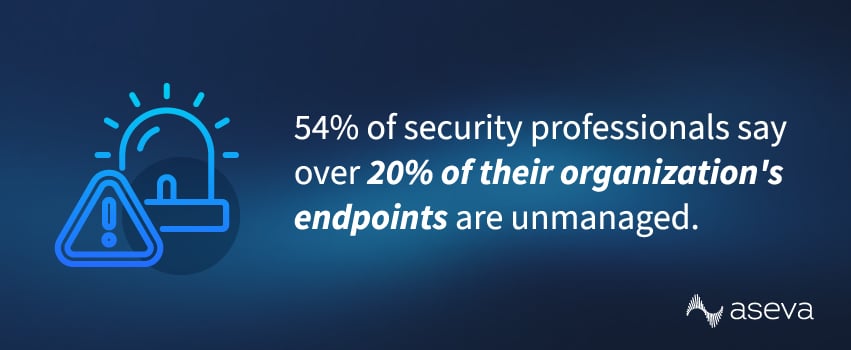
Your employees use dozens of devices to access your company's data every day. Laptops, smartphones, tablets, and workstations all connect to your network, creating entry points that attackers can exploit. A whopping 90% of successful cyberattacks and 70% of data breaches originate at endpoint devices, yet 54% of security professionals report that more than 20% of their organization's endpoints remain unmanaged.1
Endpoint management gives you the visibility and control needed to protect these devices while keeping your network running smoothly. Rather than leaving your devices scattered across your organization with minimal oversight, endpoint management brings them together under a centralized strategy that ensures they meet your security standards, stay updated, and are continuously monitored for threats.
Read on to learn what endpoint management is, how it works, and why it's essential to your organization's overall cybersecurity strategy.
Endpoint Management Definition: What Is It?
Endpoint management is the process of monitoring, securing, and maintaining all the devices that connect to your business network. These endpoints include laptops, desktop computers, mobile phones, tablets, servers, and even IoT devices. The goal is straightforward: ensure every device meets your organization's security standards, has the latest software updates, and can be monitored for network security threats in real time.
Without a centralized approach to managing these devices, IT teams struggle to enforce policies consistently, leaving gaps that attackers can exploit. Modern endpoint management solutions combine security, configuration, and monitoring into a single platform, making it easier to protect your network regardless of where your employees work or what devices they use.
What Is Endpoint Management Software?
Endpoint management software is the technology that powers your entire endpoint strategy. These platforms give IT administrators a centralized dashboard to track every device, deploy updates, enforce security policies, and respond to threats across your organization.
A typical endpoint management platform includes:
- Device Discovery & Inventory: Automatically identifies and catalogs every device that connects to your network
- Policy Enforcement: Deploys security configurations and access rules consistently across all endpoints
- Patch Management: Pushes critical software updates to close vulnerabilities before attackers can exploit them
- Remote Management: Allows IT teams to troubleshoot issues, install software, and maintain devices without requiring physical access
- Compliance Reporting: Generates documentation to prove adherence to regulations like HIPAA, PCI DSS, or ISO 27001
At Aseva, our endpoint security solutions integrate these capabilities into a fully-managed service that protects your devices without adding complexity to your IT operations.
Endpoint Security and Management: Why They Go Hand in Hand
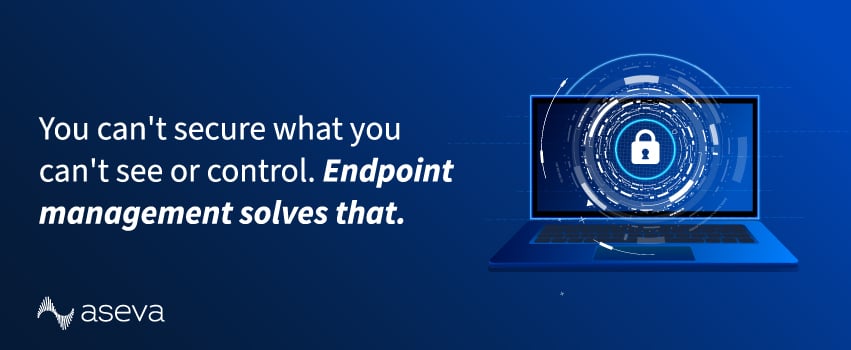
Endpoint management and endpoint security are closely connected. You can't secure what you can't see or control, and endpoint management provides the foundation for effective security. Devices that aren't properly patched, configured, or monitored create opportunities for attackers to access your network.
Managed endpoint security combines the monitoring and control capabilities of endpoint management with advanced threat detection and response. This integrated approach helps you:
- Detect suspicious activity on individual devices before it spreads to other systems or your network
- Automatically isolate compromised endpoints to contain damage and prevent lateral movement
- Deploy security patches and configuration changes across thousands of devices simultaneously
- Maintain visibility into your entire attack surface, regardless of where employees work or what devices they use
When endpoint management and endpoint security work together, you get a comprehensive defense strategy that protects every device while maintaining the visibility and control necessary to respond to threats quickly and effectively.
Common Endpoint Security Threats You Need To Know
Understanding the threats targeting your endpoints helps you build stronger defenses. Here are the most common endpoint security threats organizations face:
Malware and Ransomware
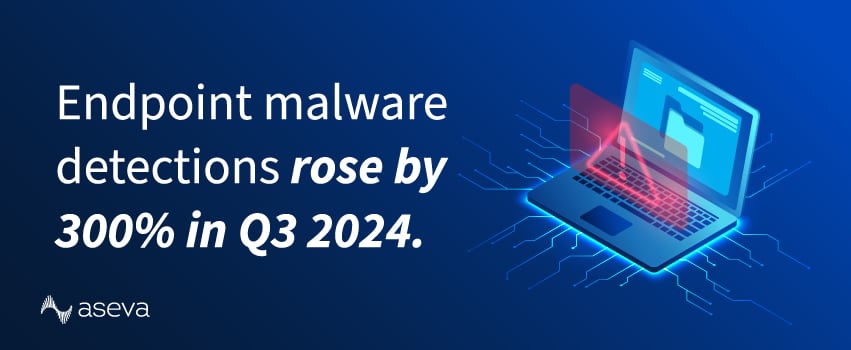
Malicious software delivered through phishing emails, malicious websites, or compromised applications can encrypt your data and demand payment for its release. Endpoint malware detections rose by 300% in Q3 2024,1 showing how quickly these threats are accelerating.
Phishing Attacks
Attackers use deceptive emails and messages to trick employees into revealing credentials or downloading malware. Once an endpoint is compromised through phishing, attackers can move laterally through your network to access sensitive data.
Unpatched Vulnerabilities
Software vendors regularly release patches to fix newly discovered security vulnerabilities. Endpoints that don't receive these updates remain exposed to known exploits that attackers can easily leverage.
Lost or Stolen Devices
When an employee loses a laptop or has their phone stolen, the device itself becomes a security risk. Without proper endpoint management, stolen devices can provide direct access to your corporate network and data.
Insider Threats
Not all security threats come from outside of your organization. Employees with legitimate access can accidentally or intentionally compromise endpoints by installing unauthorized software, sharing credentials, or accessing data they shouldn't.
Why Is Endpoint Security Management Important?
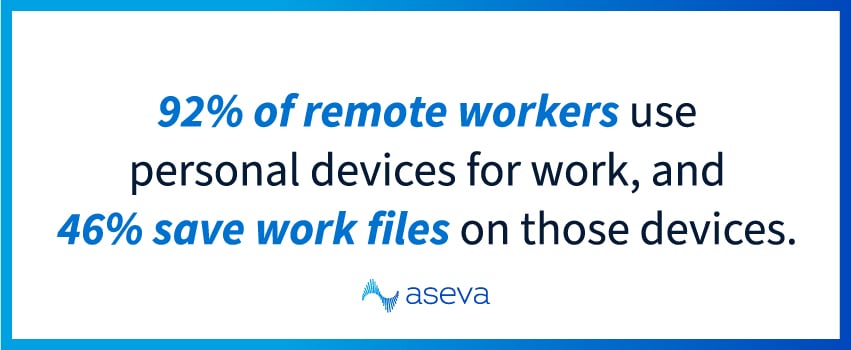
The shift to remote and hybrid work has fundamentally changed how businesses operate. Employees now access company resources from home offices, coffee shops, and airports using a mix of corporate-owned and personal devices. This distributed workforce creates challenges that traditional perimeter-based security can't address. In fact, 92% of remote workers use personal tablets or smartphones for work, with 46% saving work files on those devices.1
Endpoint security management is important because it:
- Reduces your attack surface by ensuring every device meets security standards, eliminating easy targets that attackers typically exploit first.
- Speeds up incident response since centralized visibility means you can detect and respond to threats faster, often automatically isolating compromised devices before damage spreads.
- Simplifies compliance with automated reporting and policy enforcement that make it easier to demonstrate compliance with industry regulations.
- Supports remote work by allowing employees to work securely from anywhere without compromising your organization's security posture.
- Lowers operational costs through automation that reduces the manual work required to maintain and secure endpoints, freeing up your IT resources for more strategic projects.
Endpoint security management isn't optional anymore. It's essential infrastructure for organizations that want to protect data and keep operations running smoothly.
How Endpoint Management Security Works
A comprehensive endpoint management security strategy operates on multiple levels, each working together to create a cohesive defense system.
Device Enrollment and Authentication
When a device connects to your network for the first time, the endpoint management system verifies its identity and checks whether it meets your security requirements. Devices that don't comply can be denied access or placed in a restricted network segment until they're properly configured.
Continuous Monitoring
Endpoint management platforms monitor devices in real time, tracking everything from software installations to network connections. This continuous visibility helps detect anomalies that might indicate a security incident. Your team knows what's happening on every device, all the time.
Automated Threat Detection
Advanced endpoint security solutions use behavioral analytics and threat intelligence to identify suspicious activity. When a device exhibits behavior consistent with malware or unauthorized access, the system can automatically trigger a response.
Policy-Based Controls
Security policies define what users can and cannot do on their devices. These policies control everything from password requirements to which applications can be installed, ensuring consistent security across your entire organization.
Patch and Update Management
The endpoint management system automatically deploys security updates and software patches according to your policies. This automation eliminates the delay between when a patch is released and when it's applied, closing vulnerability windows before attackers can exploit them.
Incident Response and Remediation
When a threat is detected, the endpoint management system can isolate the affected device, alert security teams, and initiate automated remediation steps. This rapid response limits the damage attackers can cause.
Best Practices for Implementing Endpoint Management
Time to strengthen your endpoint security? Here are proven strategies to implement effective endpoint management:
- Create a Complete Device Inventory: You can't protect what you don't know about. Start by identifying every device that connects to your network, including personal devices used for work.
- Require Authentication: Enforce multi-factor authentication for all endpoint access to prevent credential-based attacks.
- Deploy Endpoint Detection and Response (EDR): EDR tools provide advanced threat detection capabilities beyond traditional antivirus software.
- Automate Patch Management: Configure your endpoint management system to deploy critical security updates automatically, reducing the window of vulnerability.
- Segment Your Network: Isolate endpoints based on their risk level and function, limiting how far an attacker can move if they compromise a single device.
- Conduct Regular Security Training: Educate employees about phishing, social engineering, and safe device usage to reduce human-related security incidents.
- Partner With Security Experts: Working with a managed security service provider like Aseva gives you access to specialized expertise and 24/7 monitoring without the overhead of building an in-house team.
A strong implementation strategy combines all these elements working together. No single approach solves every problem, but a comprehensive strategy addresses your organization's specific risks and challenges.
6 Features To Look for in Endpoint Management Solutions
When evaluating endpoint management platforms, focus on these essential capabilities:
- Unified Management Console: A centralized dashboard to monitor and control all endpoints across your organization.
- Cross-Platform Support: Compatibility with Windows, macOS, Linux, iOS, and Android devices.
- Real-Time Threat Intelligence: Integration with global threat databases to identify and respond to emerging attacks.
- Automated Remediation: The ability to automatically respond to threats without requiring manual intervention.
- Compliance Reporting: Pre-built reports and audit trails to demonstrate regulatory compliance.
- Seamless Scalability: The platform should grow with your business, supporting everything from dozens to thousands of endpoints.
Our managed network security services at Aseva include all of these capabilities, delivered through a partnership that prioritizes your business outcomes over technical complexity.
Secure Your Endpoints With Aseva
Your endpoints are the gateway to your data and operations. Protecting them properly means your employees can work with confidence, your IT team can focus on business priorities instead of firefighting security issues, and your organization can grow without constantly worrying about endpoint vulnerabilities.
At Aseva, we specialize in delivering integrated cybersecurity solutions that align with your real-world requirements. Our team has been helping businesses strengthen their endpoint security for nearly 30 years, combining proven technology with hands-on expertise. Whether you're protecting a handful of devices or managing thousands of endpoints across multiple locations, we're here to provide the tools, support, and strategic guidance you need.
Ready to build the secure, resilient endpoint infrastructure your business needs? Get started with Aseva today.
Sources: