
If you're evaluating WAN options for a multi-site business, you've likely run into the SD-WAN vs. MPLS debate – and for good reason. Both technologies connect your locations and support the applications your business depends on, but they take fundamentally different approaches, with different cost structures, performance characteristics, and trade-offs.
There's no universal right answer. The better choice will depend on your mix of applications, cloud footprint, budget, and performance needs. In this guide, we’ll break down the difference between SD-WAN and MPLS so you can make that call with clear eyes – rather than defaulting to whichever technology your current provider happens to sell.
What's the Main Difference Between SD-WAN and MPLS?
MPLS and SD-WAN represent two fundamentally different philosophies about how to build enterprise networks. Let’s explore the basics of each approach:
What Is MPLS?
MPLS (Multiprotocol Label Switching) is a private, carrier-provided network that connects your business locations using dedicated circuits. Traffic is directed using labels rather than complex routing decisions at every hop, which allows carriers to guarantee consistent performance – bandwidth, latency, and packet loss – backed by contractual service-level agreements.
Because MPLS traffic stays on a private network rather than the public internet, it has long been considered the standard for reliability and security, and many enterprises built their entire WAN architecture around it for exactly that reason.

What Is SD-WAN?
SD-WAN (Software-Defined Wide Area Network) takes a different approach. Instead of relying on a single private circuit, SD-WAN uses software to intelligently route traffic across multiple connection types and find the best available path for each application in real time based on current network conditions. This makes SD-WAN inherently more flexible and typically far less expensive to deploy and scale.
Because SD-WAN is software-driven rather than tied to a specific type of physical circuit, it also gives IT teams centralized control they simply don't get with traditional WAN architecture – configuring policies once and pushing them out across every site, rather than managing individual circuits and hardware configurations location by location.
SD-WAN vs. MPLS: Key Differences
The differences between these technologies show up across multiple dimensions of your business, but here are the most important considerations:
Cost
This is usually where the conversation starts, and for good reason. MPLS circuits are more expensive than broadband internet on a per-megabit basis, and that cost adds up across every site in a multi-location business. Meanwhile, SD-WAN cuts WAN costs by 50-84% compared to MPLS in typical deployments.1
Performance and Flexibility
MPLS provides guaranteed performance through carrier SLAs, which can be a major advantage for latency-sensitive applications. SD-WAN takes a more dynamic approach, using multiple links and application-aware routing to adapt to changing conditions in real time.
What's often overlooked is that SD-WAN frequently performs better in practice for cloud-bound traffic. SD-WAN can route cloud traffic directly to the internet rather than backhauling it through a central MPLS hub, which means faster access to SaaS applications and cloud infrastructure.
Deployment Speed
Provisioning a new MPLS site can take weeks to months, since it requires a carrier to install the circuits physically. SD-WAN can often be deployed in days, using existing internet connections and centrally managed configuration. This deployment speed difference alone can be decisive for businesses opening new locations quickly or responding to market changes.

MPLS vs. SD-WAN Security: Which Is More Secure?
Security is one of the most misunderstood parts of the MPLS vs. SD-WAN comparison. MPLS has traditionally been viewed as more secure because traffic stays on a private carrier network rather than the public internet – but private doesn't mean inherently encrypted or immune to compromise.
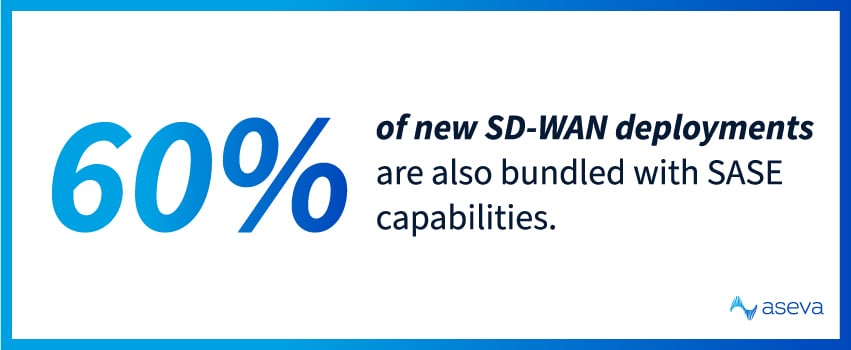
Modern SD-WAN platforms have closed this gap with built-in encryption and integrated firewalls. Over half (60%) of new SD-WAN deployments are also bundled with SASE (Secure Access Service Edge) capabilities,2 which combine networking and security into a single managed framework.
Thanks to these upgrades, a well-configured SD-WAN deployment can offer more comprehensive security than a traditional MPLS network ever provided on its own. The key variable isn't the underlying transport, but how thoroughly the security layer has been configured and maintained over time.
This is an area where implementation quality matters more than the underlying technology. At Aseva, we design our SD-WAN and SASE services to make sure security isn't an afterthought in your WAN architecture, regardless of which underlying technology you choose.
Top 5 SD-WAN Benefits Over MPLS
Beyond cost and deployment speed, there are several other SD-WAN benefits over MPLS worth understanding:
- Centralized Management: A single dashboard for configuring and monitoring your entire WAN, rather than managing circuits site by site.
- Application-Aware Routing: Traffic is automatically directed based on application requirements, prioritizing latency-sensitive traffic like voice and video.
- Direct Cloud Access: SD-WAN can route traffic straight to cloud providers instead of backhauling it through a data center, reducing latency for cloud applications.
- Vendor and Carrier Flexibility: SD-WAN isn't locked to a single carrier's private network, giving businesses more negotiating leverage and redundancy options.
- Built-In Resilience: Automatic failover across multiple links means a single connection failure doesn't take down a site.
Organizations that adopt SD-WAN don't just save money. They gain agility, resilience, and the ability to respond to business changes faster than they could with MPLS alone.
Is SD-WAN Better Than MPLS?
The honest answer: it depends on what your business needs. Is SD-WAN better than MPLS for a cloud-heavy, cost-conscious, multi-site business that needs to move fast? In most cases, yes. But is it automatically better for every organization? No, some businesses have compliance requirements where the guaranteed performance offered by MPLS is more important.
Many organizations find that the best answer isn't choosing one over the other, but using SD-WAN over MPLS selectively – running most traffic across cost-effective SD-WAN while retaining an MPLS circuit for the small subset of traffic where guaranteed performance is non-negotiable.
This hybrid model captures much of SD-WAN's cost and flexibility advantage without giving up MPLS's reliability where it matters most, and it's increasingly the default recommendation for mid-size and enterprise businesses managing a mix of latency-sensitive and standard traffic.
Build the Right WAN Strategy With Aseva
The right WAN decision depends on your unique mix of applications, your cloud strategy, your compliance requirements, and your growth plans – not on which technology is trending. That's the kind of decision that benefits from an advisor who isn't incentivized to sell one option over the other, and who can speak honestly about where each technology's tradeoffs actually show up in day-to-day operations.
At Aseva, we work with the leading carriers and SD-WAN providers across the market, and we operate our own nationwide network backbone as well. That combination means we can design the right mix for your business – whether that's a full SD-WAN transition, a hybrid approach, or keeping MPLS where it makes sense – backed by certified engineers who manage the deployment and stay involved long after. Explore our connectivity and MPLS solutions to learn more.
Get started today to speak with one of our network experts and figure out the WAN strategy that actually fits your business.
Sources: