
SASE and SD-WAN show up in the same conversations so often that most people treat them as interchangeable terms. They're not, and this confusion costs organizations that end up buying one when they actually need the other, or buying both without understanding how they're supposed to work together.
This guide breaks down the difference between SASE and SD-WAN, where each one stands on its own, and why more businesses are combining them into a single, unified strategy.
SASE vs. SD-WAN: What's the Difference?
Most of the confusion between SASE and SD-WAN comes from overlaps in capabilities and marketing messaging. Both use software-driven approaches to networking and are increasingly cloud-delivered. But they're not the same thing, and knowing what each actually does can help you make smarter decisions about your infrastructure investments.
What Is SD-WAN?
SD-WAN (Software-Defined Wide Area Network) is a technology that uses software to intelligently route network traffic across multiple types of connections – broadband internet, LTE, 5G, and MPLS – selecting the best available path for each application based on real-time conditions.
SD-WAN's biggest value is performance and flexibility: it replaces expensive, rigid private circuits with a smarter, centrally managed approach to connecting your locations, cloud environments, and remote users.
For many organizations, SD-WAN was the first major step away from traditional MPLS-centric architecture – offering comparable or better performance at a fraction of the cost, with the added benefit of centralized management across every site.
What Is SASE?
SASE (Secure Access Service Edge, pronounced "sassy") is a broader architectural framework that combines networking capabilities – including SD-WAN – with a full stack of security services, delivered from the cloud.
SASE integrates SD-WAN with capabilities like secure web gateways (SWG), cloud access security brokers (CASB), firewall-as-a-service (FWaaS), and zero trust network access (ZTNA) into a single, unified platform managed from the cloud edge, close to wherever your users happen to be.
Where SD-WAN is a networking technology, SASE is a security and networking framework that includes SD-WAN as one of its core components. That's why the SASE vs. SD-WAN comparison isn't really an either/or choice – and Aseva’s technology experts are here to help you define your scope and find the right solution, whether that’s SD-WAN alone or combined with SASE.
SD-WAN vs. SASE: Key Differences
Understanding SD-WAN vs. SASE at a practical level comes down to a few key distinctions. Here's how they compare across the factors that matter most:
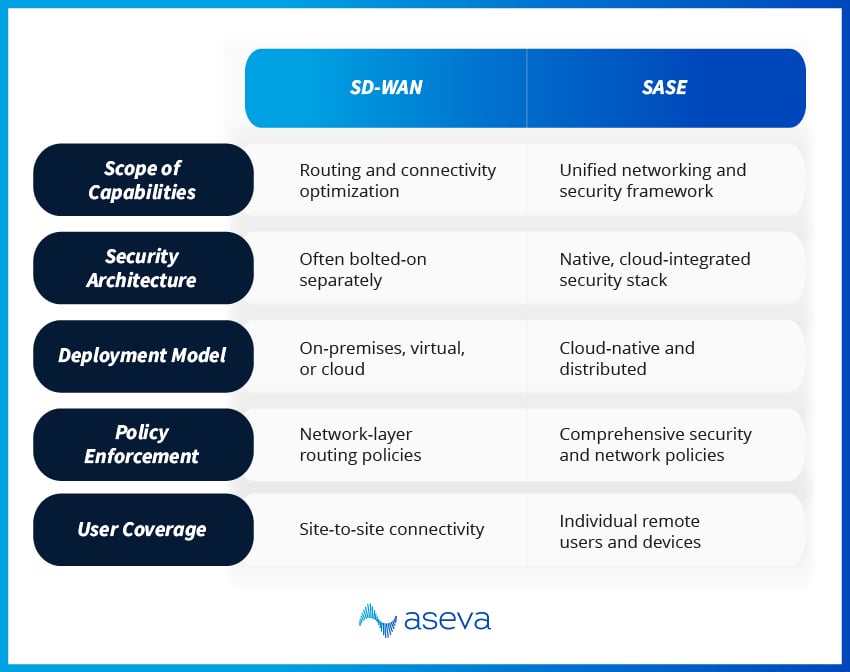
Scope of Capabilities
SD-WAN focuses on connectivity – routing traffic efficiently across your WAN. SASE integrates security into that connectivity layer, so traffic isn't just routed efficiently; it's inspected, filtered, and governed by security policy no matter where it's headed.
Security Architecture
Traditional SD-WAN deployments rely on separate, bolted-on security appliances – a firewall here, a secure web gateway there – which creates gaps and management overhead. SASE builds security directly into the architecture, applying consistent policy enforcement everywhere.
Deployment Model
Businesses can deploy SD-WAN as an on-premises appliance, a virtual instance, or a cloud-delivered service. SASE is inherently cloud-native – its security and networking policies are enforced from distributed points of presence close to users, rather than backhauled through a central data center.
Policy Enforcement
SD-WAN enforces networking policies like routing and bandwidth allocation at the network layer, giving you control over how traffic flows between locations. SASE extends policy enforcement to the security layer, applying rules about who can access what, from where, under what conditions, across your entire infrastructure.
User Coverage
SD-WAN is primarily designed to connect sites – branch offices, data centers, and cloud environments. SASE extends that same level of policy enforcement to individual remote users and devices, which has become increasingly important as hybrid and remote work have become the norm rather than the exception.
SD-WAN SASE: How the Two Work Together
SD-WAN and SASE aren’t competing technologies. They’re complementary layers of the same architecture. In fact, Gartner predicts that 65% of new SD-WAN deployments will be part of a single-vendor SASE offering by 2027.1 That’s because SD-WAN provides the intelligent routing and connectivity foundation, and SASE builds the security layer modern businesses need to stay protected on top of that foundation.
Because SASE platforms typically include SD-WAN, organizations that already have SD-WAN in place aren't starting over when they adopt SASE. Rather, they're extending their existing network investment with an integrated security framework that closes gaps SD-WAN wasn’t designed to address.
At Aseva, we built our SASE and SD-WAN around this relationship – helping businesses either start with SD-WAN and layer in SASE capabilities over time, or implement both together from the outset, depending on where you’re starting from.
When Should You Combine SASE and SD-WAN?
Not every organization needs the full SASE framework on day one, but there are clear signals that combining SASE and SD-WAN makes sense sooner rather than later:
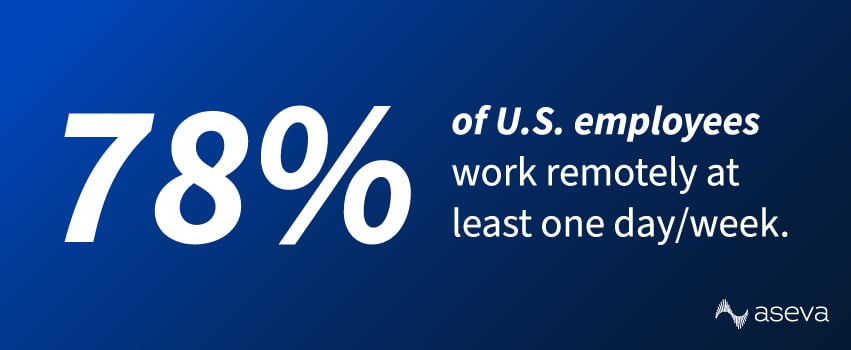
- Distributed or Remote Workforce: As of May 2026, 78% of U.S. employees work remotely at least one day each week.2 SASE extends security to these remote and hybrid workers the same way SD-WAN extends connectivity to your branch locations.
- Heavy Cloud Adoption: Organizations running significant workloads in the cloud benefit from SASE's ability to apply security policy at the cloud edge, rather than backhauling cloud-bound traffic through a central firewall.
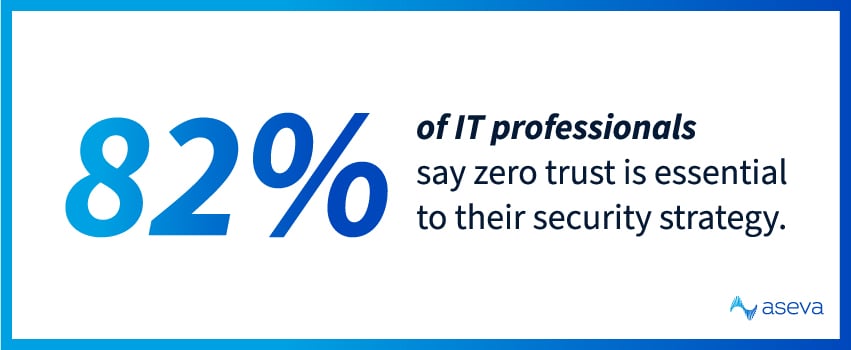
- Zero Trust Initiatives: A 2026 survey found that 82% of IT professionals say zero trust is essential to their security strategy.3 SASE's built-in ZTNA capabilities make it a natural fit for organizations actively working toward a zero trust security model.
- Security Tool Sprawl: If your current stack includes several disconnected point solutions for web filtering, access control, and threat prevention, SASE consolidates them into a single managed platform.
- Compliance Requirements: Industries with strict data protection requirements often benefit from the consistent, centrally managed policy enforcement SASE provides across every access point.
For organizations not yet ready for a full SASE deployment, starting with SD-WAN and adding security capabilities incrementally is a completely reasonable path. However, choosing an SD-WAN platform without considering its SASE compatibility upfront often means a more disruptive migration later.
Build the Right SASE and SD-WAN Strategy With Aseva
Treating SASE and SD-WAN as an either/or decision usually leads to a strategy that doesn't hold up as your needs evolve. Whether you need a quick, cost-effective connectivity upgrade or a complete framework that unifies networking and security, the right approach depends on where your business is today and where it's headed.
At Aseva, we take a vendor-agnostic approach to designing that strategy. We're not tied to a single SD-WAN or SASE platform – we work with leading providers across the market and bring our own certified engineers and network backbone expertise to make sure what we recommend actually fits your business, not just a vendor's roadmap.
Speak with one of our network and security experts today to get started.
Sources: