
With cybercrime costs expected to reach $10.29 trillion in 2025,1 it’s clear that businesses need smarter tools to protect their networks – and their bottom line. Three solutions dominating the conversation today are Endpoint Detection and Response (EDR), Managed Detection and Response (MDR), and Extended Detection and Response (XDR). While they all play an important role in cybersecurity, each offers unique capabilities that can help keep your organization safe.
In this blog, we’ll walk you through the differences between EDR, MDR, and XDR to help you understand which solution is right for your security needs.
Key Takeaways
- EDR focuses on endpoints, giving deep device-level visibility, investigation, and containment, but it requires in-house time, skills, and ongoing alert triage.
- MDR pairs detection tools with 24/7 expert monitoring and response, reducing operational load, but it depends on clear scope, SLAs, and third-party data considerations.
- XDR correlates signals across endpoints, cloud, email, identity, and network to improve context, cut noise, and catch multi-stage attacks, though it’s more complex to implement well.
- Many businesses combine them, using EDR as the foundation, XDR as the integration layer, and MDR to add expert coverage and faster response.
What Is Endpoint Detection and Response (EDR)?
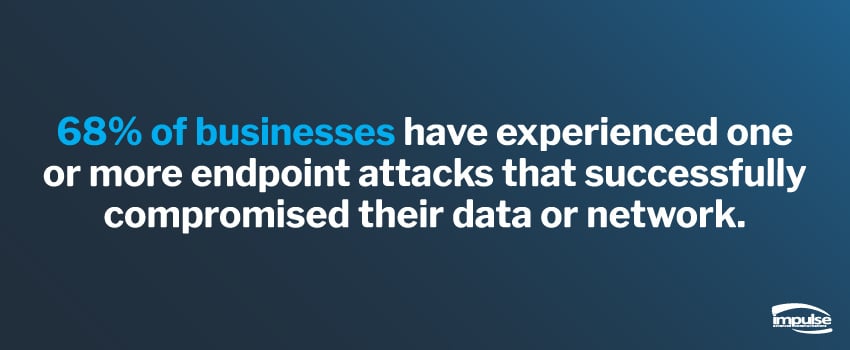
EDR monitors and responds to threats at the endpoint level. Endpoints include devices like laptops, desktops, and servers – the primary targets for many cyberattacks. One report found that 68% of businesses have experienced one or more endpoint attacks that successfully compromised their data or network.2
Some key features of EDR include:
- Real-Time Threat Detection: EDR tools monitor endpoint activity to detect suspicious behavior.
- Detailed Forensics: When a threat is identified, EDR solutions collect and analyze data to pinpoint its origin and scope.
- Automated Response: EDR systems can isolate compromised endpoints to prevent the spread of attacks.
- Threat Hunting Capabilities: Many EDR tools allow IT teams to proactively search for vulnerabilities and anomalies.
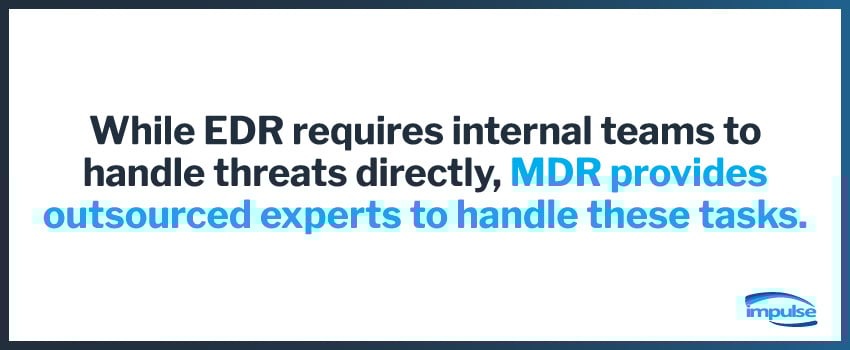
EDR works well for businesses with internal IT or security teams that can actively monitor alerts and respond to threats. However, it requires technical expertise and constant attention.
What Is Managed Detection and Response (MDR)?
MDR takes EDR a step further by bringing in outside cybersecurity expertise. MDR combines advanced detection tools with monitoring and incident response services from specialized teams.
Essential MDR features include:
- 24/7 Monitoring: MDR providers monitor your environment around the clock, identifying and mitigating threats.
- Expert Response Teams: MDR includes access to cybersecurity professionals who handle threat analysis, containment, and resolution.
- Comprehensive Reporting: Detailed incident reports help businesses understand what happened and how it was addressed.
- Scalable Protection: MDR is great for businesses of all sizes, offering flexibility as your needs evolve.
MDR is ideal for businesses that lack the in-house expertise or resources to manage complex cybersecurity operations. It lets you tap into top-tier security without building an entire security team.

What Is Extended Detection and Response (XDR)?
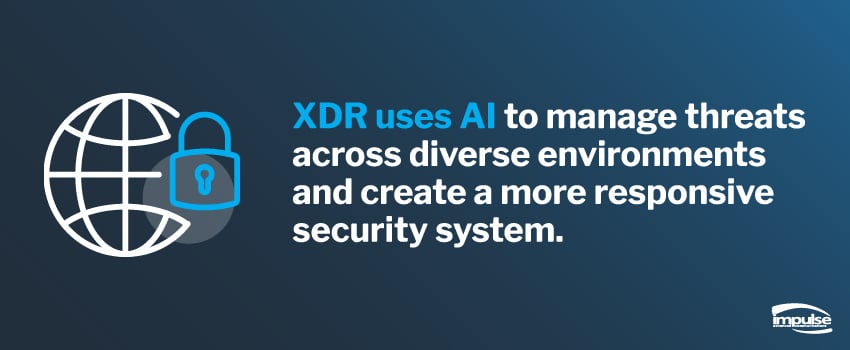
XDR builds on EDR by extending its monitoring and response capabilities beyond endpoints to include other areas of the network, such as email, servers, and cloud environments. It creates a unified platform for managing security across different layers.
Features of XDR include:
- Holistic Visibility: XDR integrates data from endpoints, network traffic, cloud environments, and more for a comprehensive view of threats.
- Enhanced Automation: Advanced AI and machine learning capabilities streamline threat detection and response.
- Centralized Management: XDR consolidates security tools into a single platform, simplifying operations for IT teams.
- Cross-Platform Insights: By correlating data from multiple sources, XDR identifies sophisticated threats that may go undetected by siloed tools.
XDR is best for organizations looking for a centralized and integrated approach to cybersecurity. It excels at detecting complex, multi-vector attacks that target multiple areas of the network.
EDR vs MDR vs XDR: Pros and Cons
EDR Pros and Cons
Pros
- Deep visibility into endpoint activity on laptops, desktops, and servers
- Strong investigative control for your internal team
- Useful for threat hunting and endpoint-focused forensics
- Lets you tune detections to match your environment
Cons
- Requires consistent monitoring, triage, and response capacity
- Alert volume can lead to fatigue for smaller teams
- Endpoint-centric view can miss context from identity, email, network, or cloud without extra tools
MDR Pros and Cons
Pros
- 24/7 monitoring and investigation handled by dedicated security experts
- Reduces operational burden on internal IT and security teams
- Helps close skills gaps without hiring a full SOC
- Typically includes structured reporting and guided response
Cons
- Ongoing service cost and reliance on a third party
- Needs clear scope, responsibilities, and escalation paths to work well
- May require extra review for data sharing, privacy, and compliance requirements
XDR Pros and Cons
Pros
- Broader visibility by correlating signals across endpoints, cloud, email, identity, and network
- Better detection of multi-stage, multi-vector attacks
- Can reduce noise by connecting related events into fewer, higher-context alerts
- Centralizes investigation and response workflows
Cons
- More complex to deploy than a standalone endpoint tool
- Value depends on integrations, data quality, and consistent tuning
- Requires clear ownership for playbooks and response across teams
EDR vs MDR vs XDR: What Are The Differences?
Scope of Coverage
- EDR focuses on endpoints like laptops, desktops, and servers. It watches endpoint behavior, detects suspicious activity, and helps you investigate and contain threats on those devices.
- XDR expands that same idea beyond endpoints by correlating signals across more of your environment, like network, cloud, email, and identity, to catch multi-vector attacks that do not stay in one place.
Who Operates It
- EDR is typically software your team runs. Your internal IT or security staff monitors alerts and responds.
- MDR is detection and response delivered as a managed service. You still get strong detection tooling, but you also get a dedicated security team to monitor, investigate, and guide or execute response actions.
Visibility and Context
- EDR gives deep visibility into endpoint activity, which is critical, but it can be limited when an attack moves across systems.
- XDR is designed to connect the dots across tools and data sources, which helps reduce blind spots and gives investigations more context.
Response Style and Workload
- EDR can respond quickly, but it demands consistent attention, tuning, and operational maturity.
- MDR reduces day-to-day workload by outsourcing monitoring, threat hunting, and incident handling.
- XDR can streamline detection and response across domains, often using more automation and correlation to reduce alert noise and speed up triage.
Which One Is “Best”
- EDR is a strong fit when you have in-house resources to own detection and response.
- MDR is ideal when you want expert coverage without building a full security operations function.
- XDR fits best when you need unified visibility and response across a broader, more complex environment.
|
Category |
EDR |
MDR |
XDR |
|
What it is |
A tool/platform for detecting and responding to threats on endpoints |
A managed service where a provider runs detection + response for you (often using EDR) |
A platform that extends detection/response beyond endpoints by correlating signals across multiple security domains |
|
Primary coverage |
Endpoints (laptops, desktops, servers) |
Usually endpoints first, but often expands based on provider scope |
Endpoints plus other layers like network, email, cloud, identity, and more (varies by vendor) |
|
Who operates it |
Your internal IT/Sec team |
A provider’s security team (24/7 in most cases) |
Typically your team, but can also be purchased as managed XDR |
|
Visibility |
Deep endpoint telemetry |
Strong visibility where the provider is monitoring (commonly endpoints + selected sources) |
Broader, cross-domain visibility with event correlation across sources |
|
Detection approach |
Endpoint behavior analytics + investigation workflows |
Tooling + human-led monitoring, triage, and threat hunting |
Cross-source correlation + analytics (often includes automation to reduce alert noise) |
|
Response |
You respond (isolation, remediation actions) |
Provider guides or executes response (depending on model) |
Can orchestrate response across domains; response depth depends on integrations and playbooks |
|
Operational effort |
Higher (tuning, triage, response ownership) |
Lower (outsourced monitoring and expertise) |
Medium to high (integration + tuning), often lower day-to-day triage once mature |
|
Best fit |
You have security staff and want stronger endpoint protection |
You want expert coverage without building a full SOC |
You have a complex environment and need unified detection/response across tools and domains |
|
Common tradeoff |
Great on endpoints, but limited context beyond them |
Less direct control; quality depends on provider + scope |
More complexity upfront (integration, data sources), and outcomes depend on how well it’s deployed |
|
Typical outcome |
Better endpoint detection + faster containment on devices |
Faster time to 24/7 coverage and guided/managed response |
Better detection of multi-stage, multi-vector attacks and more centralized operations across security stack |
How to Choose the Right Fit For Your Business
Every organization’s risk profile is different, so the right option depends on your environment, your internal resources, and how much visibility you need beyond endpoints.
Choose EDR if your business
- Wants stronger endpoint protection beyond next-gen antivirus
- Has an internal security or IT team that can act on alerts and recommendations
- Is building a scalable detection and response foundation and wants to start at the endpoint layer
Choose MDR if your business
- Needs 24/7 monitoring and response without building an in-house SOC
- Wants to add expert threat hunting, investigation, and remediation support without hiring
- Is dealing with skills gaps or limited bandwidth and needs faster operational maturity
Choose XDR if your business
- Wants broader visibility and detection across multiple security domains, not just endpoints
- Needs faster multi-domain investigation and threat hunting from a more centralized view
- Is experiencing alert fatigue from disconnected tools and wants better correlation and response speed
How EDR, MDR, & XDR Work Together
In practice, many organizations don’t choose only one of these approaches. Instead, they combine them to build a layered defense that matches their needs and resources.
EDR as the Foundation
In many environments, EDR serves as the starting point. It places sensors on endpoints and gives you the foundational telemetry you need to understand what’s happening on devices and respond to threats. Even when organizations move to XDR, endpoint data remains a core building block.
MDR on Top of EDR & XDR
MDR often sits on top of EDR, XDR, or a broader security stack. Rather than replacing your tools, the MDR team uses them to monitor your environment, investigate alerts, and contain threats. This lets you benefit from both the technology you’ve invested in and the experience of a specialist security team.
XDR as the Integration Layer
XDR brings data from multiple sources together, providing a single place to see and act on threats across your environment. For organizations that choose both XDR and MDR, XDR becomes the platform where signals are correlated and prioritized, while the MDR team focuses on analysis and response.
By combining EDR, MDR, and XDR in the right way, you can balance visibility, automation, and expert support without overcomplicating your security program.
Partner With Aseva for the Right Cybersecurity Solution
Choosing the right cybersecurity solution depends on your organization’s unique needs, resources, and goals. At Aseva, we specialize in helping mid-sized businesses navigate the complexities of cybersecurity to ensure you find a solution that solves your problems.
Our seasoned experts offer tailored guidance, implementation, and ongoing support for cybersecurity solutions, including EDR, MDR, and XDR. We’ll simplify the decision-making process – so you can focus on running your business with confidence.
Ready to strengthen your cybersecurity? Contact Aseva today to learn more about how we can help.
EDR vs. MDR vs. XDR FAQs
What is EDR vs XDR vs MDR?
EDR is a tool focused on detecting and responding to threats on endpoints. MDR is a managed service where experts monitor and respond for you, often using EDR. XDR is a platform that correlates detection and response across multiple domains like endpoints, email, cloud, identity, and network.
Is EDR the same as MDR?
No. EDR is technology you operate. MDR adds a provider’s security team to run monitoring, investigation, and response.
Is MDR the same as EDR?
No. MDR typically includes EDR capabilities, but the difference is the managed 24/7 service and expert response.
How is XDR different from MDR?
XDR is primarily about broader, cross-domain visibility and correlation in one platform. MDR is primarily about who runs detection and response, a provider doing it as a service. You can also have managed XDR.
Is EDR better than XDR?
It depends. EDR can be “better” if you only need strong endpoint coverage and have staff to run it well. XDR can be “better” if you need visibility and response across endpoints plus cloud, email, identity, and network, and want stronger correlation for complex attacks.
Do I Need Both EDR and MDR?
In many cases, yes. MDR services often rely on EDR or similar tooling to collect endpoint telemetry and respond to threats. EDR provides the technology, while MDR brings the expertise and 24/7 coverage needed to get the most from it.
Sources: