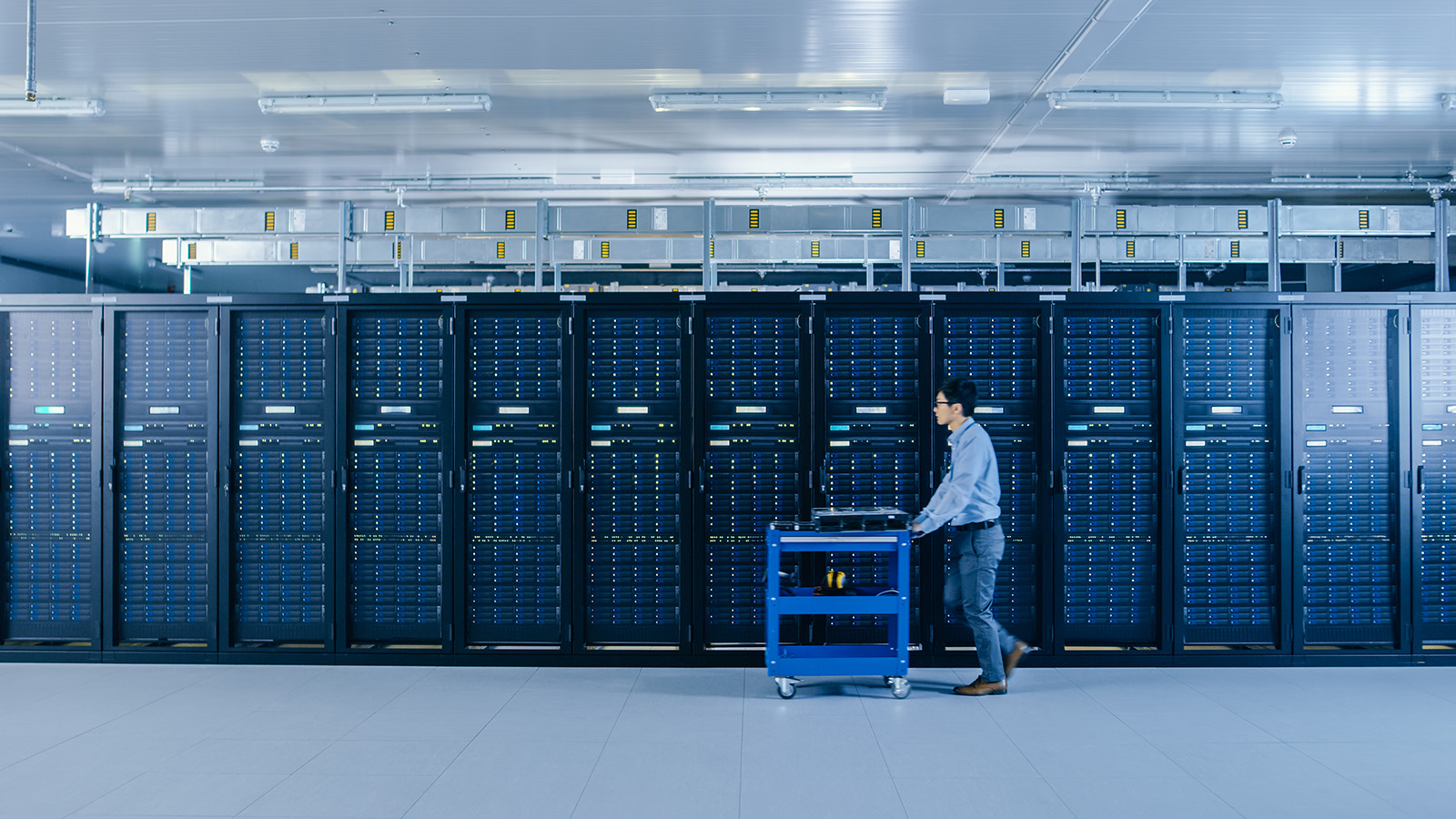
Running your own server room sounds like control – but in practice, it means managing power redundancy, cooling systems, physical security, and connectivity infrastructure that has nothing to do with your core business.
For organizations that want enterprise-grade infrastructure without that operational burden, colocation is worth a serious look. And the timing couldn't be better. Global data center capacity is expected to double by 2030,1 with cloud adoption and AI workloads driving demand for more infrastructure.
Read on to learn what a colocation data center is, what the right colocation facility can do for your business, and how to find the best fit for your specific needs.
What Is a Colocation Data Center?
A colocation data center – often called a "colo" – is a shared facility where businesses rent space to house their servers, networking equipment, and storage hardware. Instead of building and maintaining your own private data center, you place your equipment inside a professionally managed facility that provides the physical infrastructure, including power, cooling, connectivity, and physical security.
This model has become increasingly attractive as organizations face growing complexity in their IT environments – AI workloads, in particular. AI only represented about a quarter of all data center workloads in 2025, but is expected to represent half of all workloads by 2030.1 Colocation is helping businesses meet the demand for these compute-intensive workloads by providing the power, cooling, and scalability they need without massive capital investment.
What Is a Colocation Facility?
Colocation data center design is built around one goal: maximum uptime. It's a building engineered with layers of redundancy that most businesses can't replicate on their own. That means redundant utility feeds, uninterruptible power supplies (UPS), on-site generators, precision cooling, and physical security that includes biometric access controls, 24/7 surveillance, and on-site staff.
Network connectivity is where colocation really separates itself. Tier 1 facilities connect directly to multiple fiber carriers and internet exchange points, giving your infrastructure access to high-bandwidth, low-latency paths that would cost far more to source independently.
Colocation Data Center Examples
Colocation data center examples span industries and organization sizes, such as:
- A regional financial services firm colocating to meet compliance requirements and ensure uptime for customer-facing systems.
- A healthcare organization housing its patient data infrastructure in a HIPAA-compliant colo facility.
- Multi-site enterprises using colocation as a WAN hub to connect branch offices back to a centrally managed environment.
The common thread in each use case is that data center colocation lets businesses leverage professional infrastructure without building it from scratch.
Colocation Data Center Benefits: 7 Reasons Businesses Make the Move
Still not convinced? Here are the biggest reasons why more businesses are adopting data center colocation:
1. Cost Reduction
Building a private data center requires major capital investment in space, power, cooling, and staffing. Colocation converts that capital expenditure into a predictable operating expense where you only pay for what you use, when you use it.
For most mid-size businesses, the economics strongly favor colo over private facilities. You avoid the construction timelines, the ongoing maintenance costs, and the capital financing that comes with owning dedicated space.
2. Enterprise-Grade Uptime
Tier 3 and Tier 4 colocation facilities are designed to deliver 99.982% or higher availability. While that level of reliability is theoretically achievable in a private server room, it's prohibitively expensive to build and maintain. You'd need backup generators, UPS systems, multiple utility feeds, redundant cooling systems, and the staff to operate and maintain all of it.
Colocation facilities spread those costs across hundreds of tenants, making enterprise-grade reliability economically accessible to businesses of all sizes. You get the uptime guarantees that your business needs without having to build and maintain that infrastructure yourself.
3. Superior Network Connectivity
In a private data center, you're limited to the carriers and internet providers that serve your physical location. But in a colocation facility, you have choices.
Carrier-neutral colocation facilities let you connect with the providers that best fit your performance and cost requirements – and you can switch between carriers without moving your hardware.
Direct cloud on-ramps like AWS Direct Connect or Azure ExpressRoute also deliver faster, more reliable connections to cloud workloads than traffic routed over the public internet.
4. Physical Security and Compliance
A compliant colo environment simplifies audit readiness and reduces risk for organizations in regulated industries.
Colocation facilities maintain compliance certifications that many businesses would struggle to obtain on their own: SOC 2, PCI DSS, HIPAA, ISO 27001, and others. You don't have to design and implement security controls from scratch, as the facility already meets industry standards.
5. Scalability Without Capital Risk
Most colo providers offer flexible cabinet, cage, and suite options that let you start with what you need and add space as your business grows, without construction timelines or upfront commitments.
This means that if your infrastructure needs to double, you can add capacity quickly. If demand shifts, you can adjust your footprint to match. That flexibility is valuable if your business conditions aren’t predictable.
6. Business Continuity and Disaster Recovery
A colocation facility provides a physically separate environment for disaster recovery infrastructure: offsite backups, a warm standby, or a full DR site. Housing recovery infrastructure in a geographically separated colo is a straightforward, cost-effective way to strengthen your business continuity posture.
Rather than trying to maintain a secondary data center or relying on cloud-only disaster recovery, you can use colocation to create a hybrid approach that gives you both ownership and geographic separation.
7. IT Team Freed Up
Your infrastructure team shouldn't be spending their time managing cooling systems or coordinating with facility maintenance. They should be building and optimizing the applications and services your business depends on.
Colocation removes the operational burden, so your engineers can concentrate on work that directly supports your business strategy.
How To Choose the Right Data Center Colocation Partner
Not all colocation facilities are created equal. A few of the most important factors to evaluate when you’re comparing providers include:
- Tier rating
- Uptime SLAs
- Carrier neutrality
- Distance from your offices and internet exchange points
- Compliance certifications
- Scalability
- Quality of on-site remote hands support
Navigating these decisions is where an experienced, vendor-agnostic advisor makes a real difference. At Aseva, we work with leading colocation providers – including Equinix, CoreSite, and Iron Mountain – but we're not tied to any single facility.
We operate our own nationwide network backbone, which means we bring both independent infrastructure expertise and access to the industry's best providers when helping you choose the best-fit colocation partner for your business.
Get Expert Colocation Guidance Without the Vendor Bias
Colocation is a significant infrastructure decision, and the market is full of providers with compelling pitches. What most businesses need isn't another vendor presentation – it's an objective perspective on which facility, connectivity options, and contract terms actually serve their interests.
That's exactly what the Aseva team provides. Our role is to help you evaluate options objectively, negotiate on your behalf, and provide support after you’ve signed the contract. Learn more about our colocation services and how we approach infrastructure decisions alongside cloud and connectivity strategy.
Whether you're colocating for the first time, re-evaluating an existing facility relationship, or building out a hybrid infrastructure strategy, our certified engineers are here to help. Speak with one of our infrastructure experts today.
Sources: