
Most organizations run regular vulnerability scans. Fewer put their defenses to a real test. Penetration testing closes that gap by doing what an attacker would do, under controlled conditions, before the wrong person gets the chance.
The difference matters: manual penetration testing uncovers nearly 2,000 times more unique vulnerabilities than automated scans alone.1 However, a pen test is only as effective as the methodology behind it.
Read on to learn what the penetration testing steps involve, how to prepare, and how to make sure you’re getting genuine value from your testing partner.
What Is Penetration Testing Methodology?
A penetration testing methodology guides how testers execute and document this type of security assessment. With a defined methodology, every relevant attack surface is examined systematically, the findings are reproducible, and the results can be compared across engagements over time.
Widely recognized frameworks include:
- PTES (Penetration Testing Execution Standard)
- OWASP for application testing
- NIST SP 800-115
Experienced testers will adapt their approach to the specific environment, scope, and objectives of each engagement. What matters most is that the methodology is rigorous, documented, and applied consistently.
Network Penetration Testing Methodology
Network penetration testing methodology focuses on the infrastructure connecting your environment, including your routers, switches, firewalls, VPNs, and wireless networks.

This framework evaluates both your organization’s external-facing attack surfaces (what an attacker outside your network could reach) and internal attack surfaces (what a threat actor with initial access could do from inside).
External vs. Internal Network Security Penetration Testing
External testing covers internet-facing services, firewall rule validation, and exposed management interfaces.
Internal testing simulates a compromised endpoint or malicious insider, focusing on lateral movement and sensitive system exposure from an end user’s position.
Aseva’s penetration testing services cover external and internal network assessments, application testing, and social engineering simulations – giving you a complete picture of your exposure across every major attack vector.
How Often Should You Perform the Penetration Testing Phases?
Most compliance frameworks, including PCI DSS, HIPAA, and SOC 2, require testing at least annually and after significant environment changes. But keep in mind that annual testing is a floor, not a best practice.
If your organization deploys new apps, makes major infrastructure changes, migrates to the cloud, or operates in a high-risk industry, you may need more frequent testing.
The Penetration Testing Process: 7 Pen Testing Steps Explained
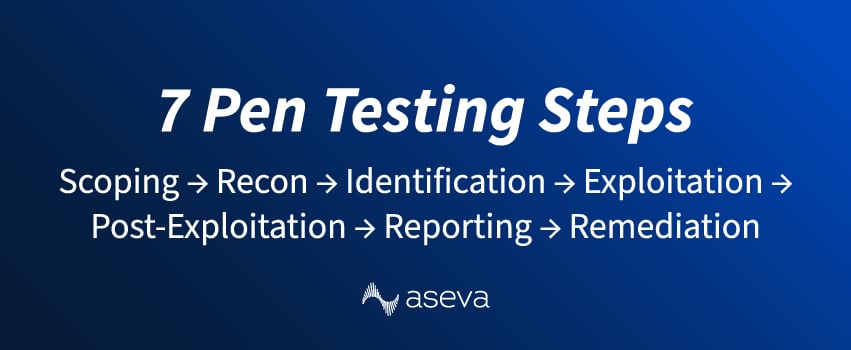
The pen testing process follows a logical progression, and skipping or compressing any of the stages will ultimately reduce the test’s accuracy. Here’s a standard penetration testing process diagram of what you can expect during an engagement:
Step 1: Scoping and Planning
An effective pen test should start with a clearly defined scope that outlines:
- Your timeline
- The systems and networks in play
- Authorized testing methods
- Rules of engagement
You’ll also determine the testing type in this stage – black box (no prior knowledge), white box (full access to architecture), or gray box (partial knowledge).
Step 2: Reconnaissance
The goal during the reconnaissance stage is to build the same picture an attacker would construct before launching an attack. Testers gather information about the target environment before making direct contact.
Passive reconnaissance draws from public sources like DNS records, WHOIS data, certificate logs, and open-source intelligence, while active reconnaissance involves direct interaction like port scanning and service enumeration.
Step 3: Vulnerability Identification
Recent forecasts show that we’ll likely reach 59,000 Common Vulnerabilities and Exposures (CVE) disclosures in 2026.2 Testers use automated scanning tools and manual analysis to look for vulnerabilities across your mapped attack surface.
Automated tools uncover known vulnerabilities, while manual review helps catch any logic flaws, misconfigurations, and context-dependent weaknesses that scanners miss.
Step 4: Exploitation
Testers actively attempt to exploit identified vulnerabilities – using the same tools and techniques a real attacker would use – to determine whether they can gain unauthorized access, escalate privileges, or reach sensitive systems and data.

Responsible exploitation is conducted carefully to avoid causing damage or unplanned downtime. A finding that can be exploited is treated very differently in a remediation plan than one that cannot, which is why this step is essential.
Step 5: Post-Exploitation
Testers will explore what a real attacker could accomplish from an exploited endpoint – attempting privilege escalation and lateral movement through the network to reach additional systems, data stores, or domains.
If post-exploitation testing reveals that lateral movement through your IT environment is too easy, the fix may require network segmentation, firewall policy changes, or identity and access management improvements – areas where Aseva’s managed network security team can provide expert guidance.
Step 6: Reporting
Professional pen test reporting delivers a technical document with precise details your security team needs to reproduce and remediate findings, along with an executive summary that communicates business risk to leadership.
Every finding should include a severity rating, evidence of exploitation, business impact context, and specific remediation guidance – prioritized so your team knows what to address first.
Step 7: Remediation and Retesting
A responsible testing partner supports your remediation process by:
- Clarifying findings
- Advising on fix approaches
- Retesting to confirm that vulnerabilities have been closed
Retesting is especially important for high and critical findings, where an unresolved gap can put your business at significant risk.

Put Your Defenses to the Test With Aseva
Knowing your vulnerabilities on paper is very different from seeing what a skilled attacker could actually do with them. Penetration testing turns theoretical risk into real evidence, so your security team gets what they need to close the gaps before attackers exploit them.
At Aseva, we take an advisor-first approach to penetration testing. We work with leading security testing platforms and experienced practitioners to design engagements that fit your environment, your compliance requirements, and your objectives – and we stay involved and accountable from scoping through retesting.
Connect with one of our cybersecurity experts today to design a pen testing engagement built around your needs.
Sources: